



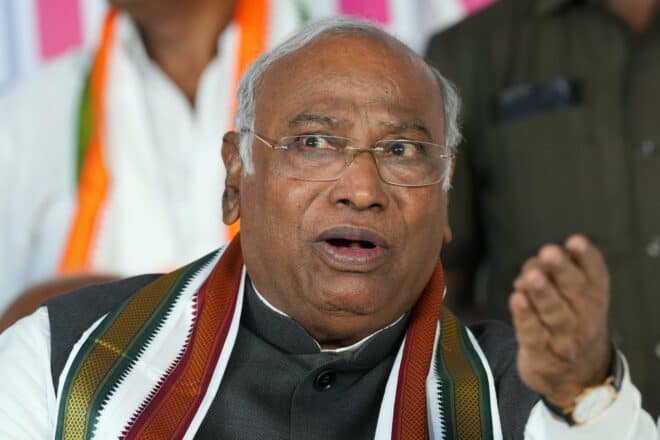
In the long and complex history of the Indian National Congress, few leaders embody organisational loyalty and grassroots credibility as profoundly as Mallikarjun Kharge. His election as Congress President in October 2022 marked a historic departure from nearly a quarter century of Gandhi family stewardship, making him the first non-Gandhi party chief in 24 years. At a time when the party was confronting electoral setbacks and internal introspection, his elevation signalled both continuity and institutional renewal. Rather than emerging through charisma-driven mobilisation, Kharge rose through decades of disciplined organisational work, reinforcing the Congress tradition of leadership shaped by structure and ideological commitment rather than spectacle.
Born on July 21, 1942, in Warwatti village in present-day Bidar district of Karnataka, Kharge’s early life was marked by social and economic hardship. Educated in Gulbarga (now Kalaburagi), where he completed his graduation and law degree, he first displayed leadership as General Secretary of the Student Union at Government College. As a practicing lawyer, he became closely associated with labour unions, defending workers in industrial disputes and earning the enduring nickname “Solillada Sardar” — the leader who never lost an election. His formal entry into the Congress in 1969 coincided with a transformative phase in Indian politics. In 1972, he was elected to the Karnataka Legislative Assembly from Gurmitkal, beginning a rare record of nine consecutive Assembly victories spanning nearly four decades. Handling key portfolios such as Revenue, Rural Development, Industries, Transport, and Water Resources across successive state governments, Kharge established a reputation for administrative rigour, land reform initiatives, and strengthening Panchayati Raj institutions.
Kharge’s shift to national politics in 2009, after winning the Lok Sabha election from Gulbarga, marked a new phase in his public life. As Union Minister for Labour and Employment, he focused on expanding social security for unorganised workers, strengthening Employees’ State Insurance coverage, and broadening provident fund access. In 2013, as Minister of Railways, he emphasised safety and institutional stability during a challenging period for the ministry. Following the Congress defeat in the 2014 general elections, Kharge was appointed Leader of the Congress Party in the Lok Sabha, becoming one of the principal opposition voices despite limited parliamentary numbers. Later elected to the Rajya Sabha in 2020, he assumed the role of Leader of the Opposition in 2021, where he consistently raised concerns on federalism, institutional autonomy, agrarian distress, and legislative scrutiny, earning cross-party respect for his measured and constitutionally grounded interventions.
Kharge’s election as Congress President in 2022 represented both symbolic and structural significance: a senior Dalit leader ascending to the party’s highest office through an internal electoral process. As president, he has prioritised booth-level restructuring, revival of frontal organisations, opposition coordination, and internal dialogue, while maintaining organisational continuity. His leadership style rests on consensus-building rather than populism, administrative discipline rather than rhetorical flourish. A consistent advocate of social justice, reservation safeguards, and constitutional protections, he has carefully balanced identity representation with institutional responsibility. From the Assembly corridors of Karnataka to the national Parliament and party presidency, Kharge’s five-decade career reflects endurance, discipline, and principled politics. In an era often defined by immediacy and spectacle, his journey stands as a testament to steady organisational work and democratic resilience.
The author is a Congress Grassroots Leader based in Bengaluru
 OpinionExpress.In









Comments (0)