



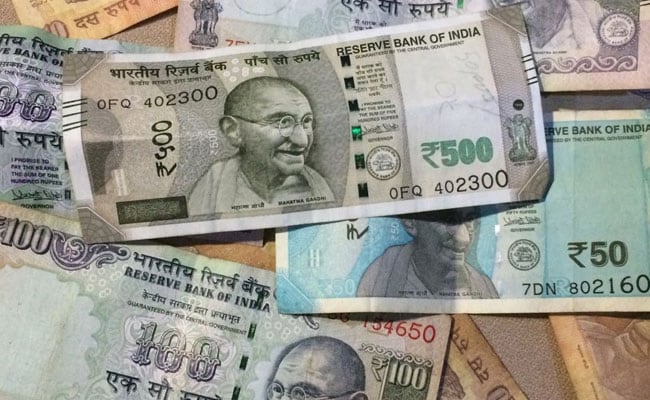
At a petrol station on the outskirts of Pune last week, a truck driver named Rajan watched the pump tick past ?4,000 for the second time this month. "Last year it was ?3,200 for the same tank," he said, shaking his head. "Everything goes up, nothing comes down." He is not wrong. And what is happening at that pump is not merely an Indian story it is the clearest illustration of what happens when three global forces collide inside one economy at the same time.
India's rupee has lost nearly 14% of its value against the dollar since early 2025, sliding past ?96 this month, levels not seen since the taper tantrum year of 2013. Crude oil, which India imports almost entirely from abroad, is trading between $111 and $121 a barrel. And the yield on India's 10-year government bond has climbed to 7.1%, its highest in two years. Individually, each of these would be manageable. Together, they form a loop that is proving very difficult to break.
Here is how the loop works. Rising crude means India needs more dollars to pay for oil. More dollar demand weakens the rupee. A weaker rupee makes each barrel of crude cost even more in local currency terms, so India needs still more dollars. Foreign investors, watching the currency fall, pull their money out. That selling drives the rupee lower still. Rajan's fuel bill rises again.
This is not abstract. India's daily crude import bill at $114 per barrel is roughly ?650 crore above what the government budgeted. Analysts at Emkay Global estimate that if Brent stays above $105 for another month, a ?10-per-litre fuel price hike becomes unavoidable, pushing inflation past 4.4% and closing the door on any interest rate relief the Reserve Bank of India had been considering. The government, sensing the pressure, has already raised petrol and diesel prices twice in a single week. It also slapped higher import duties on gold and silver on May 13, hoping to slow the dollar bleed through discretionary imports. These are the actions of an administration playing defence.
The bond market has noticed. When oil prices spike, inflation expectations rise, and bond investors demand higher yields to compensate. India's 10-year yield has moved in lockstep with every crude jump this year. That matters for equity investors in Mumbai but it also matters for a pension fund manager in Amsterdam deciding whether Indian government debt is worth holding when US Treasuries offer 4.4% in a currency that, unlike the rupee, is not losing value. The answer, increasingly, is no. Foreign portfolio investors have withdrawn the equivalent of roughly $31 billion from Indian equities in 2026 alone.
And yet India's stock market has not collapsed. The Nifty 50 closed above 23,650 on Wednesday, recovering 250 points after an intraday sell-off. The reason is quietly remarkable: domestic investors, ordinary Indians putting money into mutual funds through monthly systematic investment plans, have become a structural counterweight to foreign flight. Their inflows now regularly absorb what FIIs sell. It is one of the more underappreciated shifts in any major emerging market over the past decade.
But domestic resilience has its limits. It can absorb volatility; it cannot reprice oil. And the uncomfortable truth is that the one thing most likely to resolve India's triple squeeze is not a policy decision in Delhi or Mumbai, it is a diplomatic agreement in Geneva or Muscat. A credible end to the US-Iran conflict would send crude below $100, stabilise the rupee, and hand the RBI back its rate-cutting toolkit in a matter of days. No domestic measure comes close to that in speed or scale.
That geopolitical dependency is itself the lesson. India has spent a decade building the institutions SEBI’s investor protections, the mutual fund infrastructure, the digital payments architecture that have deepened its capital markets. Those foundations are real. But an economy that imports nearly nine-tenths of its oil has structurally outsourced a portion of its monetary policy to whoever controls the Strait of Hormuz. The truck driver in Pune understands this intuitively, even if he would not use those words.
The rupee's slide is not a crisis. But it is a signal that the rewards of deeper markets and a growing investor base can be quickly offset by the vulnerabilities of energy dependence and currency exposure. Rajan's fuel bill will not be fixed by a stronger Nifty. And a government serious about India's next decade of growth would treat his pump receipt as the policy document it is.
 OpinionExpress.In














Comments (0)