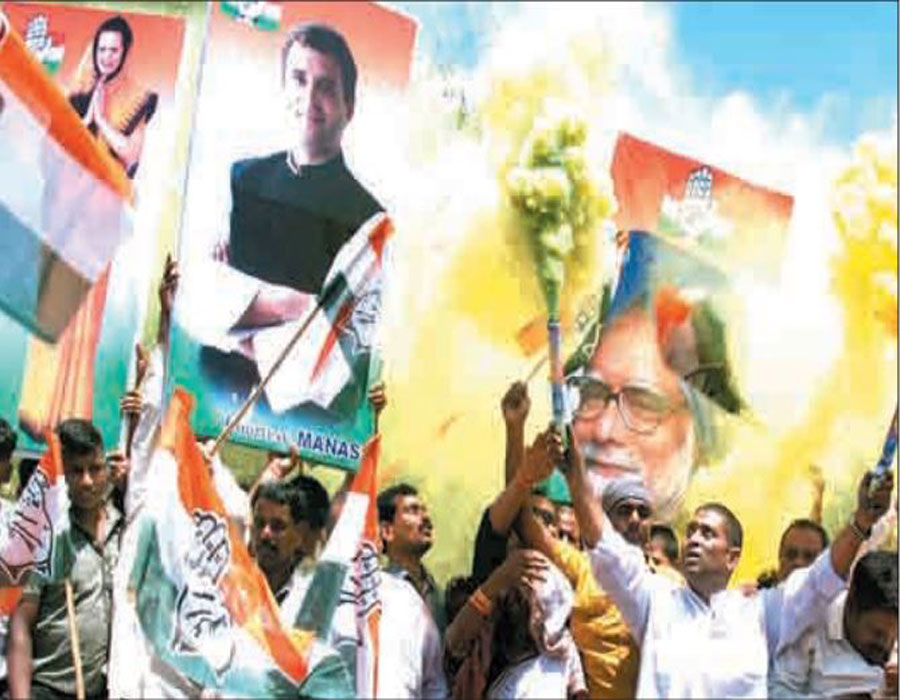
Though its early days to judge Akhilesh wave that swept UP recently, the architect of Samajwadi Party's outstanding win, Akhilesh Yadav as Chief Minister of Uttar Pradesh has a tough task on hand in tackling lawlessness and fulfilling promises made in his party manifesto.
His skill would be under test in dealing with the issue given the background of the militant image of SP workers, he has an uphill task of dispelling Samajwadi Party's image of being lax in tackling lawlessness. But within days of assuming office, Akhilesh Yadav has disappointed many people by giving the impression that these pressing concerns may be beyond his ability to deal with.
A disproportionately large number of ministers inducted into his government have long histories of crime, serious attacks on political opponents of the ruling party, and on dalits, have taken place.
If crime persists and “goonda raj” — which many thought characterised the SP’s previous tenure — returns, an environment hospitable to industry, social cohesiveness and political stability will prove elusive. We hope the CM can rise above the constraints imposed by the core social base that brought him to office.
Another uphill task for him would be in his dealings with the party seniors who may be upset at the sudden transition taking place in it. Azam Khan and Shivpal Yadav initially relented the idea by putting Mulayam Singh’s candidature to head the UP government but Mulayam Singh was firm in putting Akhilesh on the driving seat hence trounce was made between them. Despite being aware of the power he wields in SP, Akhilesh always presented himself as a modest young man.
His challenges also include ways to fulfil his poll manifesto of providing tablets and laptops to high school and intermediate pass-outs, doling out unemployment allowance which would cause excessive burden on the state exchequer. Dispelling the common perception that the Samajwadi Party led by his father Mulayam Singh Yadav had an old school mindset, Akhilesh as the party's chief campaigner emerged as its modern face in the assembly elections.
Forging ahead against personal attacks from rivals, the civil environment engineer talked about development shedding SP's image of being anti-computers and anti-English. The architect of Samajwadi Party's outstanding win was also firm in denying election tickets to candidates with criminal antecedents.
Though to Akhilesh Yadav credit, he is growing in a mature mass leader with huge fan following amongst youth in the state. He is perceived to be the bridge between conventional ideology of samajwad and modern outlook in the party fold. Fortunately for him, he has tasted power in the past hence the present post will not make him berserk. Akhilesh remains a level headed young leader even after the coronation as Chief Minister of countries largest state. Now the serious business of governance will test the character of rising star of Indian politics.
In the UPA's scheme of things, politics appears to have taken precedence over economics, The big underlying positive message for this years is that high growth is here to stay, though global factors might periodically dampen it. Accompanying this prognosis is one that is as unpalatable as it is bold - inflation to is here to stay. In the next financial year, the economy could expand 9-9.25%, while higher savings and investment, coupled with India's demographic dividend, could propel it to an ever-higher trajectory in the years to come. But it sounds like a note of caution on infrastructure and the fiscal deficit. Higher growth would push up inflation by 1.5 percentage points, and capital flows from overseas are also adding to domestic inflationary pressures. The solution is familiar: strengthen food security, provide subsidised fertilizers, and ensure financial inclusion. The other part of the prescription might not be politically easy for a government reeling under an Opposition attack on price rise as well as corruption. In fact, it even talks of not cracking down on all forms of hoarding and compares it with cholesterol which can be good and bad.
Some of the suggestions evoke a strong sense of deja vu: for instance, boosting farm productivity through a second green revolution and stepping up investment in the sector which accounts for nearly one-fifth of the economy and supports over half the population. Another suggestion that is a blast from the past is on plugging leakages in government schemes, especially the public distribution system. The recent survey cites studies to show that leakages in the PDS are anywhere between 40% and 55%. The way out is also something that has been talked about for at least half a decade: direct cash transfers. The UID could help the cause and a beginning could be made with kerosene. One clear break from the past is arguably also a telling indicator of the mood of the times - there is a moral science lecture of sorts against the backdrop of a string of scandals that, corporate chiefs say, is also affecting policy-making. The document talks about the need to foster a culture of honesty and trustworthiness for rapid and robust growth. The Union budget 2011 however failed to tackle the two most urgent issues namely inflation and corruption affecting millions of Indians at the lowest level, but I assume that this is the cost that we will be paying to sustain high growth rate momentum. Furthermore, Supreme Court ordered the removal of CVC PJ Thomas has put the government on the mat And has dented the brand Manmohan tremendously.
India is the second fastest-growing economy in the world after China and with a projected population growth of 180 million people every ten years, the country needs a lot of housing. The Government of India's Ministry of Housing & Urban Poverty Alleviation recently reported an immediate need for 26.53 million houses with additional growth of 7.37% from 2007 to 2012. Meanwhile, India's middle class is growing exponentially. A recent report by McKinsey Global Institute, the economic research arm of the international consulting group McKinsey and Company, states that India's middle class currently constitutes 50 million. By 2025 this will exceed to 583 million - roughly 41% of the population. These household incomes will grow to 51.5 trillion rupees, ($1.1 trillion USD), the report says, 11 times today's level and 58% of total Indian income. This means India's housing industry needs another 62.8 million houses by 2025." According to the Government of India approximately US$200 Billion will be required over the next 7-10 Years for Basic Infrastructure Projects". In India alone, The Economic Intelligence unit estimates that an 80 Million unit housing shortage exists, 40 Million of this in urban areas. It is evident that the infrastructure of our nation has to be addressed in all areas and modernized to the levels of developed nations. The numbers quoted are enormous and of a truly staggering proportion. Frankly, the state of the nation's infrastructure remains severely out of date and built to the requirements of many decades ago and is not capable of supporting the largely increased population which is expected to surpass that of China by 2050.
Regrettably, the Indian system works to frustrate the transaction, for example, in certain areas such as Land Registration, Title Clearance and Land Conversion there is a convoluted and arduous process here at best. This can be made completely transparent and easily accessible through legal reforms with appropriate laws enacted and a well-managed, organized electronic database. These simple procedures would increase global and national competitiveness, encourage entrepreneurship and simultaneously increase national productivity, development and distribution of higher-quality products and services resulting in lower consumer pricing. This is a reason why since 1980, Our Northern neighbor China has attracted approximately $345 billion USD in FDI, while India has languished behind at a mere $18 billion USD.
Few realize that while 54% of the US's $13 trillion GDP is linked to its organized realty industry, India's real estate currently constitutes only 3% of the GDP, (projected to reach 12% by 2015.) India's real estate sector has only been open to foreign investors since 2004. Foreclosure laws were introduced the same year under the Securitization Act. No residential mortgages existed until early 2000 and no land loans, construction loans, Real Estate Investment Trusts (REITs) nor conventional construction finance like we know it in the West exist to this day.
Indian real estate development has declined in the last year because of the global economy, primarily a knee-jerk reaction but it will resurge strongly due to the country's projected population growth (180 million per decade and 70% growth in major metro areas per decade.) Cushman & Wakefield Research is equally optimistic. A recent paper, it states that India's real estate will remain robust, especially in its residential market.
Addressing India's Housing and Infrastructure requirements is an immense task that will require everyone's cooperation at all levels. It is now very clear that we need to continue to create this alternative framework or system in the Urban Infrastructure & Housing sector through aggressive and rapid reforms. The corporatizing of this sector to international levels and making it attractive to FDI can and will bring great benefits to us through large FDI flows in this sector.
So the time has come to jump the ravine in one giant leap. A series of feeble jumps can only lead to inertia and a further lack of productivity. So the question in front of us is whether we have the industry resolve to enact the necessary measures required at the policymaking level. If we can, the results will be immediate and relief will be clear as we tap into the enormous power of the international money markets. Their favor to our nation will in effect provide an invaluable equity component when channeled into our infrastructure projects and their financing provision will affect massive infrastructure and housing developments greatly benefiting the nation of India and her children as well as all parties involved.
Corruption is a global phenomenon hence we cannot be critical about ourselves regarding practicing corrupt practices yet India is suffering because the corruption is affecting lowest strata of our country badly. We must support person of conviction, integrity and high morala namely Manmohan Singh, Pranab Mukherjee, Subramanian Swamy who has single handily fought the most complicated 2G scam of the present time. Fortunately, we have a large number of honest people living in India but with no unity unlike dishonest people who tends to form a close syndicate to protect respective interest. Raja & Radia duo investigation is likely to lead to many more surprises if the investigation is done honestly wherein the trail of money split can led to many Cabinet ministers, bureaucrats, media persons. All the progress in the CWG, 2G scam, Food scam is having to common indicator that our honest Prime Minster is gradually loosing authority over governance leading to formation of lobbyist both within and outside government that takes and influence crucial decisions for the government. Unfortunately it is proving a simple point that Dr Manmohan Singh honeymoon of UPA1 is over, secondly it reflects Sonia Gandhi authority is diminishing fast within the party (ref Jaganmohan Reddy challenge, Digvijay Singh's conduct) and outside the party in the UPA II alliance (conduct of DMK, NCP and TMC). The cross-connection of Raja & Radia duo in the opposition parties and media and judicial domain in India do establish a point that money can influence high and mighty with ease. The non-ethical practices adopted by certain powerful families by forming political party to give official colour to the fudual proxy power is a blot to the largest democracy in India.
The politicians with access over huge unaccounted cash generated out of corrupt system have established tremendous stronghold over bureaucracy, Judiciary and media and the fallout is natural. The people with power are now in a position to flex muscles blatantly without fearing of the consequences. Anil Ambanis, Vijay Mallya, Satyam Raju are the icon for new emerging India, uncensored ridiculous films and television shows are high on demand that is breeding moral corruption in our society, convicted stars like Sanjay Dutt and Salman Khan are having the biggest following amongst youth of the country and off course lobbyist Radia and cabinet minister A Raja are running our government, Suresh Kalamadi and Lalit Bhanot are assigned by us to run the sporting arena of the country, surely even a man with limited common sense can predict the fallout for the nation. It is a must for people of India to think again, because people of the country have the ultimate power to elect government. The democracy has matured a lot in India but the crucial question is that whether our citizens at large have understood the value of honest competent governance. For me, we lack political options hence people are running out of option to identify a right cord.
Congress Party is grasping to breath, opposition parties are focused on immediate gains ignoring the long term national interest. Why BJP and left has deliberately ignored to raise CWG and Food grain scams earlier? 2G scam is focused on DMK and putting pressure on Congress party to take action that shall lead to DMK exit hence fall of government is their primary motive, but the corruption must be raised without party affiliation to punish the guilty. Supreme Court intervention in the 2G scam to monitor the investigation is a welcome step and country must seek an explanation from the ruling elites to come out clean or perish.
Commonwealth Games 2010: Incompetent and Deceptive
An amazing sequence of comedy of errors led to national shame, but the player on the ground are unfazed. Just when you think you have seen the last joker of the Commonwealth Games organizing committee, someone would come forward and prove you wrong. The latest addition to this illustrious list is Lalit Bhanot. From Scam to Sham, from Game to Shame, it seems we have it all in our endeavour to organize the so-called best CWG ever. This is turning out to be a melodrama which could even send all Ekta Kapoor's serials packing. The antiques and our responsibility-ducking attitude have yet again brought a truck full of shit and a whole lot of shame to our nation.
What was initially thought of as a scam (Indians shouldn't complain, as scams are in our blood) has turned out to be a grand-scale deception. I am now sure of their modus operandi - Keep on dragging your feet and don't act till the point someone presses the panic button. Then the last minute the Jugad funda of us Indians would come into play and funds would be released. No questions asked and then it's all about filling our pockets and fooling a billion-plus population. If it was not an attempt at deception, then why was the media was shown only a few selected Games village towers 10 days ago? Why were rosy pictures drawn before all of us? When reality came asking about its legitimacy, 10 days later we have fallen apart like a pack of cards. Suddenly all are critical of the Games, including the two Mikes (Hooper & Fennell). When the same pair were all praised for a brilliant Games village 10 days back, why are they critical now? Why are they running around with threats and giving us 24-hour deadlines to clean our posteriors or forget the Games? Uncomfortable but mandatory questions need to be answered in a hurry.
Let's see how it all started and what Mr. Bhanot has to say when the CWG directors turned psychotic about the hygiene factor in the Games village. Instead of accepting the flaws, he tried to teach all of us the theory of relativity in terms of hygiene. I am not sure how violently Albert Einstein would have turned in his grave. This brilliant attempt of his which might not win him a Nobel Prize left all of us high and dry. His statement was bizarre, ridiculous, disgusting and shameful - all at the same time. Does he have any idea that the whole world would be watching him blabber and would be dropping to the floor laughing at us? What he meant, when he said we have our hygiene standards and they have theirs, is out of my wavelength. Does he want to suggest that we Indians are filthy and living in the dark ages without an idea what hygiene is all about? Does he want foreigners should come to teach us about hygiene? Does he want to say that we are Jaahil and uncultured as a nation? You might be thick-skinned Mr. Bhanot but for all of us, your jingoisms are shameful, to say the least. Forget the scam, forget the incompetence - for this bizarre statement of his, he should be sacked at once.
If you think you are done with all the gimmicks then look at another genius - Maj (Retd) Dalbir Singh (Games village mayor). When hounded with the same hygiene questions, he was clueless and was at sea to say the least. I can't elaborate on what he said about various factors, as nobody can. So I better just list them one by one
It was for sure a bad day and the best was reserved till the last. Out of nowhere a foot overbridge near the Jawaharlal Nehru stadium gave in. This eventuality made the queen of the opera to come to the stage with her polished Miranda house ac-cent. How I can forget her flamboyant cotton Saree? When asked how each day a new bloody thing can happen to the CWG, this is what she has to say - The foot over the bridge was for the aam admi (so shouldn't be attached with CWG), not the players. So? Aam aadmi can die as long as you can save your back from the CWG ghost? Mam, can you imagine what would have happened - if a few athletes were right below and the bridge
crashed on their heads? Don't bother how many of the aam aadmi the bridge might take a long while crashing on the poor athletes' heads. As per her, the builder is blacklisted and some bloody enquiry would be carried out with reports expected in three weeks. So for the next three weeks, we shouldn't bother her by showing our filthy and unhygienic faces. Let me admit - I am still in dilemma, whether to cry or laugh at these stupid statements. To top all this, a section of the roof in the wrestler's arena of the Jawaharlal Nehru Stadium collapsed, and the Delhi CM, Ms. Sheila Dixit's riposte was that small things keep happening.
The Games are fast turning out to be more irritating than anything. It is only because we have walked (read fooled ourselves) too far, we have no option left but to save our face and restore some respect of our nation, which was badly maligned by a few crooks. M.S. Gill can promptly walk away from the cameras (no single word uttered) without taking any responsibility or even bothering to explain how he allowed so much mess to continue for years altogether. But we are not shameless like Mr. Gill and continue to pray our typical Indian Jugad might just see us save our already blackened face and red ass a little, one more time. I will offer a coconut at the nearest Ganpati temple from my side if we manage to do so. But on second thought - why can't all these rascals go somewhere and hang themselves instead? Skunks!
However, a serious follow-up of the ongoing much-published public loot would be crucial to ensure growing India's international clout. The government of India must take the blame for the mess because the entire responsibility of the mess, Urban Development ministry is the apex body to control the various agencies including Indian Olympic Association headed by legendary Suresh Kalmadi. Indian PM owes a responsibility to explain the inaction despite the media and opposition parties have raised the doubts since last year or so.. UPA chair-person has assured strict action against the guilty but we know how justice is delivered in India hence keep no hopes there.. Very soon we may locate Kalmadi & Co in a seven-star hotel rubbing shoulders with top leadership and media people for the damage control PR exercise to bring calm and sanity, Indian are by and large considered accommodating people hence they will forgive the guilty. But the core question here is who will pay for the dent of India Inc global brand? The CWG mess will affect the India Inc brand, and business environment, it will put Indian diplomacy on the back foot leading to political chaos.
Rs 1 lakh crore CWG scam? Will Manmohan Singh speak up
New Delhi: Upping the ante over the alleged corruption in Commonwealth Games, the Opposition parties claimed that the scam is to the tune of Rs 1 lakh crore. The CWG scam rocked the Parliament, Indian media and people at large.
"The total money involved in CWG scam is Rs 1 lakh crore. I have the documents to prove it," JD-U chief Sharad Yadav said.
"There are so many areas of corruption uncovered," said RJD chief Lalu Yadav amid demands that Prime Minister Manmohan Singh must answer.
Even as the Opposition aims to target the Congress-led United Progressive Alliance (UPA) Government in Parliament over the issue of alleged financial irregularities in the Commonwealth Games, fresh allegations have surfaced against Organising Committee Chairman Suresh Kalmadi suggesting he was aware of payments made to controversial UK-based firm AM films and its sister concern AM Car and Van Hire.
Congress President Sonia Gandhi on Thursday said those found guilty of corruption in the upcoming Commonwealth Games will be punished once the event is over. "The Prime Minister is looking into the corruption charges against the Commonwealth Games " said Gandhi, at a meeting of the Congress Parliamentary Party (CPP).
"The Commonwealth Games are not related to any political party or individual. It is a national pride and efforts should be made to hold them successfully," she added.
The destructive face of CWG 2010 - Kalmadi
As the soon-to-start Commonwealth Games (CWG) is getting mired in one controversy after another and is being flagged as a national shame, the people of one village in Karnataka are upset more than anybody else. It's Kalmady, the native place of CWG Organising Committee chief Suresh Kalmadi near Udupi.
Suresh Kalmadi's father and grandfather used to live in this village but moved out 50 years ago. As Suresh Kalmadi's name has been popping up in the media in connection to the Games, the locals of Kalmady village feel that the name of their village is getting tarnished. "We are not worried about the conduct of the Games, we are perturbed because the name of our village keeps popping up for the wrong reasons on national media every time Suresh Kalmadi's name is mentioned," said the Kalmady Yuvaka Sangha members.
Former president of the Udupi Town Municipal Council Somashekar Bhat, also a close associate of the new state minister of higher education VS Acharya said, "I feel bad about the controversies surrounding Suresh Kalmadi and CWG. People have been asking me and my party workers about what's been happening." Sudharkar Salian, a political leader in Kalmady told DNA, that he plans to send a letter to the media saying: "We disown the name Kalmady attached to a controversial person like Suresh Kalmadi. However, there is one comforting factor that Suresh Kalmadi's surname is being spelt as 'Kalmadi' and not 'Kalmady', the name of our village."
‘India has itself to blame for the Commonwealth Games 2010 chaos’
India has only itself to blame for the gigantic mess of the Commonwealth Games, says Mike Hooper, the CEO of the Commonwealth Games Federation.
"We have a host city contract that clearly says that the responsibility for the implementation and delivery of all those promises that were made, all the standards, etc were the Government of India, the Delhi Government and the Organising Committee. We don't have the resources to deliver that. That comes down to the host. We pass on all the rights associated with the games to the host. What we try to do is to support and work with the Organising Committee. But ultimately to get the work done and to do it, that is the responsibility of the stakeholders in India, " Hooper told NDTV.
The CEO of the Commonwealth Games Federation added, " The buck stops with all the stakeholders. We now hope that between now and October 14, we see a successful celebration of the games. “
In this last week, the Athletes' village was found in a such filthy condition that a few countries lodged formal complaints with the Organizing Committee. Apartments meant for use by participants and officials were described as "un-liveable." New Zealand has hired its own cleaners to prepare for its contingent's arrival.
Hooper denied stating in the past that the Games Village was better than the one used in Beijing for the Olympics. "we were aware of the filth in the Village on September 15," Hooper said, emphasizing that he went public with details of the unhygienic conditions only after assurances on cleaning up the village were not met. Toilets were found choked with human refuse. One bed had been soiled by a dog.
Hooper also trained his guns on the Indian Sports Minister, MS Gill., describing his "monsoon wedding" re-mark as unacceptable. He said, " There is a reason why the Games are awarded seven years earlier and that is because there is a huge amount of work to do. The Minister of Sport talks about the monsoon wedding approach. That is unacceptable. The reality is, the venues did not start on time. Had they started earlier, we wouldn't be in half the predicament we've seen in recent months." In July, Gill had said, "Commonwealth Games is like an Indian monsoon wedding. Everything is being done at the last minute."
The yawning gap between concept and execution
Now that the commonwealth games are less than a fortnight away and the monsoons showing no signs of abating, the preparations are really going down to the wires. Honestly, I am more than a little confused about whether to support the games or not. At one level, I have started feeling bad for the organisers.
The rains have been so relentless that even those who are well-intentioned and want to do a genuinely good job are frustrated. Also, most of us don't want to be embarrassed. But then, I tell myself that some of these jokers, which basically means the top guys in the organising committee and the civic administration and their political masters, have had 7 years to get things ready, and delayed things deliberately to create panic so that no question asked funds are released. So they deserve no mercy.
And then again, the thought creeps up. Why should the nation be embarrassed for the folly of these individuals, especially when we know that those responsible for the mess are thick-skinned?
The Prime Minister and his boss, Sonia Gandhi, have promised that the guilty will 'not be spared' once the games are over. But do you really believe that one bit? I can almost envision the games being projected as a grand success and in the ensuing euphoria, all would be forgotten, including the fact that what should have cost X has cost us 20 X and that the quality has been shockingly sub-standard, the excessive makeup and magical illumination of games venues notwithstanding. Of course, those responsible would move on and perhaps even bid for the Olympics to build on the hugely successful commonwealth games.
While all such issues, be it quality, games a success or not, who's guilty and who's not, etc will be discussed thread-bare for times to come, I have a few very basic observations, borne mostly out of my walking and cycling trips all around the city these past few days. I am sharing a few of them very briefly with the intention of getting feedback from you all.
If you are in the car, the newly laid stones on the sidewalks around Delhi look beautiful. But looks can be deceptive. Step out of the car to know what the reality is. I wouldn't be exaggerating if I say one can't walk more than 20 steps before encountering some obstacle. It could be in the form of a broken tile, a missing tile, the stump of a discarded light pole, a sudden depression that has been plastered over, or a sudden change in level. If the intention was to provide walkways that care for the pedestrian, it has fallen flat. And the experience is uniform, whether it is VVIP areas or areas around the event venues. Even the tactile tiles, that have ostensibly been put to help the blind, as is done in the developed world, have been done without a thought. You could end up in a bush or in a pile of debris.
Also, in an attempt to make the sidewalks more disabled-friendly, ramps have been built. But like a lot else, it seems to have been done just because they were asked to build a ramp. No thought has gone behind why it needs to be built in a particular way so that it actually helps those in need. There is no uniformity in the gradient or the access points and that is just part of the problem.
Another heartening feature visible, if you are moving around in cars, is the cycle lanes being created at a number of places.
Little excites me as much as this, for I genuinely believe a bicycle is ideal for travelling short distances. But like the sidewalks, their execution leaves a hell of a lot to be desired. The lane's width can switch from a few feet to a few inches, and worse, it can often lead to a dead end or into a tree.
Basically what is happening is that all these are being done just because some worthies thought all this is needed in an international city, without a clue as to how it is to be executed. There is science behind tactile tiles, or the angle at which disabled-friendly ramps are to be built, for example, but it'd be churlish to expect that anyone is even aware of these aspects. It hurts.
It really hurts. How we are being milked can be gauged from the fact that most of those involved in the implementation of these projects have spent a considerable amount of taxpayers' money on overseas study tours to learn the implementation of such projects. In the absence of any feedback or accountability, one just ends up spending a lot of money with almost zero benefits.
Just some training and awareness could have resulted in the creation of civic facilities that Delhi perhaps deserves as the capital of a growing economic power.
But instead, we are creating infrastructure that is neither here nor there. In fact, if one were to sincerely follow the signage put up all over, one could actually get into a spot of bother.
A number of our readers, I am sure, are aware of what is being done and have an opinion on how it should be done. They would have travelled the world too. Would appreciate your feedback and suggestions and put them together to be shared with the authorities. I can only hope this will somehow help in future. It is easy to give up and live with the rot, but then that is taking the easy way out and we don't want that.
(Indian Press reporting on CWG mess, by Rajesh Kalra courtesy TOI)
Thumbs Up For Brand Manmohan, It’s a mandate that has surprised all, including Congress. Result: Manmohan Singh becomes only the second Prime Minister after Jawahar Lal Nehru to be re-elected to the chair
The people of India have delivered a clear verdict, In the highly polarised and seemingly unpredictable general election of 2009 at a historic threshold of coalition politics in the country, the Indian people have given a clear-cut thoughtful verdict by voting for stability, predictability and moderation. Indians have clearly opted for the centrist views in politics, diplomacy, and economy. While taking up the challenge to seek a renewed mandate from the people, Congress projected Dr Manmohan Singh as the persona of predictability and stability in national politics. Sonia Gandhi provided much-needed balance in the Congress's public discourses. The Congress duo has obtained pan-Indian approval. Nobody can doubt that after reading the much-awaited numbers.
India is alive and young, the nation is full of optimism. The world is looking at India with respect and hopes to provide qualitative leadership in science and technology. Every night, young radiologists in Bangalore read CT scans e-mailed to them by emergency-room doctors in the U.S. Few modern Americans are surprised to find that their dentist or lawyer is of Indian origin, or are shocked to hear how vital Indians have been to California's high-tech industry. In ways big and small, Indians are changing the world.
That's possible because India, the second most populous nation in the world, and projected to be the most populous by 2025 is itself being transformed. Writers like to attach catchy tags to nations, which is why you have read plenty about the rise of Asian tigers and the Chinese dragon. Now here comes the elephant. India's economy is growing more than 8% a year, and the country is modernizing so fast that old friends are bewildered by the changes that occurred between visits. The major credit for writing the entire script goes to present Prime Minister Dr Manmohan Singh, though India is fortunate to have successive quality leadership in the late Rajiv Gandhi, late PV Narsimha Rao and Atal Bihari Vajpayee over the last three decades. All the leaders formulated a developmental policy for the nation resulting in a major surge in Indian position globally.
The Congress-led incumbent government has got such a convincing mandate that it is well-placed to provide a stronger government than it provided from 2004 to 2009. People can heave a sigh of relief that a period of political stability lies ahead for five years. The Congress will talk about inclusive growth as it did last time, but in the coming days the stock exchange will have reasons to rejoice as the Left parties are out of New Delhi's power structure.
The Prakash Karat-led era of Left dominance in New Delhi is ending on a highly controversial and humiliating note. No doubt, the Communist Party of India-Marxist is being rocked to its very foundations. A historic turning point is at hand for the Indian Left, comparable in magnitude to the split in 1964. In the conceivable future, the CPI-M will be forced into a mood of introspection and a painful course correction.
In sum, the quintessence of Election 2009 lies in that India still remains what it always has been through millennia -- a centrist country of people who opt for moderation and balance, especially in troubled times in their tumultuous history. The Indian electorate has elected this government headed by Dr Manmohan Singh to fight economic downtrend, hostile border states promoting rouge ideologies and terrorism, growing Naxal trouble challenging internal security and to counter corruption in public life to make government apparatus more transparent.
(Writer is Editor, Opinion Express Group)
It is the NDA Vs UPA agenda; a young leader with a conventional mind versus an experienced leader with h new thought process, India needs a stable and strong government
Setting a new agenda for the Congress party ahead of the forthcoming Lok Sabha election, the young party general secretary Rahul Gandhi called for giving more representation to youth in electoral politics.
Pitching for the need of making "work" as the only criteria for selecting candidates for polls, the Amethi MP said, "Religion, caste, region or economic condition should be the criteria if we want genuine and promising youth leaders to join politics for serving the nation."
Addressing the grass-roots level Congress workers at a national convention in the capital, Rahul also said that though the country has an influential percentage of the young population, youth does not find it convenient to join politics.
"They have that intention and energy to work for the community and for the nation. They feel none raises the voice of people even after getting elected. We need to demolish all walls to make it convenient and reward for youth to join politics," the young leader said.
Taking up the case of block-level and district-level workers and their leaders, Rahul said that though they are responsible for the party's victories and they lead the protest march their cases are overlooked when it comes to the distribution of tickets. I am strongly in favour of these people getting their due share. We should not import someone else and ignore their role," the leader said.
The achievements of the UPA government were all the 52 schemes that were running in the country, but National Rural Employment Guarantee Act (NREGA), Right To Information (RTI), Nuclear Agreement and debt waiver to the farmers would be the key issues, said Rahul Gandhi adding, ''implementation of acts like NREGA and RTI was a historical step for the country's future.
However, experienced Advani is promising to change the primary focus of the software industry from outsourcing for foreign economies to making it mainly India-centric, BJP's Prime Ministerial candidate L K Advani today said an NDA government "will create a new policy climate" to achieve this aim. "Whereas much of our software industry labours to make foreign economies more competitive, a BJP-led government will create a new policy climate where we use technology mainly for India's - I would add, Bharat's -- sustainable development," Advani stated in the foreword to the party's IT Vision document.
"Whereas much of our software industry labours to make foreign economies more competitive, a BJP-led government will create a new policy climate where we use technology mainly for India's - I would add, Bharat's -- sustainable development," - Advani said.
The comment comes at a time when the US and other western countries have said that they would check outsourcing to India to boost their sagging economies and growing unemployment.
The saffron party leader said his government would bring about a radical shift of emphasis in favour of "agriculture, rural economy, infrastructure development, small and medium enterprises, the informal sector of the economy, affordable healthcare for all, meaningful education for all.
And national security, both internal and external". Promising to make the "internet as ubiquitous as electricity", Advani said an NDA government would create 20 IT-related jobs in every village. This would mean 1.2 crore IT-enabled jobs in the rural hinterland of the country, he said.

FREE Download
OPINION EXPRESS MAGAZINE
Offer of the Month