
News Destination For The Global Indian Community


News Destination For The Global Indian Community



Corona’s privacy concerns
by Arun K Pujari / 07 May 2020With changing transnational contours of the app economy, where the jurisdictional functionality of service providers is questionable and operates in clouds, India needs to strengthen data laws
The Government’s directive to all public and private sector employees to install the Aarogya Setu app in their mobile phones has raised eyebrows in some quarters. But the fact is that a post-COVID world is going to be equated with a digital society. It will be the new normal, where the use of diverse and converged digital technologies will help people maintain social distancing and facilitate secured living in an age of pandemic.
The Aarogya Setu app is designed to keep the people informed about the risk of them being infected with Coronavirus. Self-assessment begins with a request for information such as gender, full name, age, countries travelled to in the last 30 days and professional details. The app, which makes the use of GPS to get the user’s location, discovers other available applications near his/her device using bluetooth. By cross-referencing the location details with that of Indian Council of Medical Research (ICMR)’s database and by collecting records of nearby users, it does a risk assessment and returns with a colour-coded message. It appears that the app continuously collects the user’s data and uploads them to a Government server along with a DiD, which is a unique digital id. Data in the server is anonymised in such a manner that personalised features are suppressed without affecting the statistical features of the data ensembles.
The fact that devices exchange information, continuously collect location data of registered users and maintain a record of the places where they may have come in contact with other people has given rise to a sense of distrust among the people. Hence, the controversy. Arguments can be drawn into two fields: One of data privacy and the other on surveillance. While debate around the Aarogya Setu app is unsubstantiated and unfounded, questions related to data privacy will very much be a talking point in a post-COVID society.
Data is now widely being treated as the new “oil”, “gold” and is a valuable resource from the perspective of society, economy, polity, privacy and human progress. For a society to make progress from an information age to a knowledgeable, digital world (data-driven society), the effective use of data and information, while qualifying with privacy parameters, will be a cornerstone of public discourse. Privacy is as old as mankind and has a close connection with human dignity, freedom and independence of an individual. Maintaining privacy will be more challenging in an age of informed society. Data privacy is a necessity so as to preserve and protect personal information that is collected by organisations. The fear of it being used by a third party is always there.
Data privacy assumes significance as people live with the app economy for the entire day, every day and every hour. Digital citizens, while accessing various apps, give in to the consent clause and in reciprocation forfeit intimate details to data companies by accepting the fine print of services that they receive through the app. Further, several devices often track our movements, preferences and any information they can mine from our digital existence. This without the consent of the user.
Let us be clear at this stage that collecting data, however private it may be, with the user’s consent, implicit or explicit, for any purpose and using it for data analytics in anonymised form is not a breach of privacy. Of course, unless the data is personalised and shared with other platforms or a third party. This seemingly is not the case with the Aarogya Setu app at present.
The nation has just seen that all efforts to curb the rapid spread of the Corona pandemic can be seriously affected due to contact tracing. This can be minimised with the help of data-driven technology that collects contact history of individuals. Undoubtedly, contact history is private but is used for a public cause. Aarogya Setu ensures just that and is a proof that India is growing to be a digitally matured State.
Post the COVID pandemic, India will witness a rise in app-driven socio-economic activities. Every aspect of the digital society — spanning from e-commerce, digital marketing and learning, digital art and culture, digital banking and transactions, social networking and social media, to digital Government interventions — will spread ominously.
Collection of data, private or otherwise, is inevitable and unavoidable in a data-intensive and algorithmically governed society. At the same time, the use of data responsibly while also preserving privacy should be the order of the day.
This brings us to an important question: Is India prepared to regulate data laws in the cyberspace? Further, are the citizens digitally educated to understand the trade-off between “comfort” and “luxury” while using digital technologies or when they share their data for a purpose? Are they aware of the privacy concerns arising thereof? These questions need to be addressed by digital communities of a post-COVID society.
India’s legal system, too, can be construed as half prepared to deal with concerns arising out of data privacy violation in the app economy and highly integrated digital age, even though the Information Technology Act (2008, amended in 2011) provides the necessary legal regime for cybersecurity and protecting privacy concerns thereof.
With changing transnational contours of the app economy, where the jurisdictional functionality of service providers is questionable and operates in clouds, India needs to consolidate and strengthen data laws on priority.
The Personal Data Protection Bill, 2019, which is still stuck in Parliament, intends to regulate the processing of personal data of individuals (data principals) by the Government and private entities (data fiduciaries). The Bill must provide legal teeth to data protection authorities to prosecute the data fiduciaries with penal actions. Such regulation, even if passed, cannot be effectively compliant in the context of lacking digital citizenship practices and etiquette.
A post-COVID society and democracy in India will be digitally driven and will be converged around data privacy and security that should not be devalued due to the current political bickering on the installation of the Aarogya Setu app. The app has only a limited purpose to contain the spread of the Corona infection. At the same time, developers of the app must take care to ensure that the data collected for the purpose is not intruded, de-anonymised or exploited by any other party.
(Writer: Arun K Pujari; Courtesy: The Pioneer)

An urban disturbia
by Opinion Express / 06 May 2020‘Bois locker room’ chats show how boys of elite Delhi schools engage in deviant behaviour against fellow girl students
When teen boys in elite schools in our metropolitan cities talk about raping or gang-raping their classmates, share nude pictures of underage girls, objectify them and post sexually explicit chats, it means just one thing, that India, as a nation has failed its women/girls. That bestiality is a natural response even among the young, too easily molly-coddled as “raging hormones.” And that education is basically an exchange value for a good life and not true knowledge or enlightenment. How else does one explain this abominable, unhealthy and sexist mindset among the privileged lot of society that continues to see the opposite gender through a medieval stereotype? As an object of prey of possession. How else will we then rationalise the sexual deviance of uneducated juveniles? So, it shouldn’t surprise us when our sensibilities are repeatedly shocked by the outing of “bois locker room” chats of the kind that came out this Sunday. Or the one a few months ago, in which the “bois” in question were as young as 12. What is more frightening is that all these cases involve children of well-heeled parents, who come from “good families” and have had entitled and privileged lives. Liberated even, without developing a mindset to handle the spirit of liberalism. And if these boys think that it is their right to treat women as sex objects then we, as parents, have done a bad job of bringing them up. We have not raised them to respect women/girls, treat them as equals and not objectify them. We have not brought up gentlemen but brutes and misogynists. Spare the rod and spoil the child goes an old adage. That changed when post-liberalisation, the world opened up and millennials were exposed to unfiltered content as part of their experiential education in a new, wider world, courtesy the internet and cellphones. With corporal punishment banned in 2010 and severe strictures against teachers if they overstepped child rights, schools, too, became cagey about stepping into or monitoring extra-curricular or non-school activities. So what do we do now? We have a generation of spoilt, brazen and sexually-depraved boys, who will one day be men and wield power of some sort over someone of the opposite sex. How many Weinsteins have we raised?
For now, we have to be satisfied with the fact that one of the 22 schoolboys has been taken into custody and more have been identified as the police investigate the horrific Instagram group chat that has been deactivated. The teen has identified 21 of the boys who were active on the group and his phone has been seized by the Cyber Cell of Delhi Police. But what of all those groups that no one knows about. And can we truly just blame the boys? What about unsupervised teens left to their own devices by busy parents? What about the expensive gadgets they are showered with to assuage parental guilt or just to get them out of our hair? Do we ever take the time and see what they are getting up to in their free time or locked away in their rooms? Have we ever taken the time or trouble to sit with them and talk about sex and the importance of consent? Have we ever given them the confidence that if they have questions about sex they can come to us and we will educate them as we do for every other thing? And what about the easy access to porn? Most are initiated into sex through these sites which objectify and degrade women. Violent images that get seared in their impressionable minds and desensitise them, making them think that women are meant to be violated. What of the criminal justice system that teaches them that you can get away with it? Our power brokers and politicians don’t make the best role models for our youth. So it is not enough or done to point fingers at the boys, we as a society have a lot to answer for. And some of the answers to these tricky questions are certainly not going to be of our liking. This is reflected in our crime graph. If the latest NCRB data is anything to go by, 33,356 incidents of rape were reported during 2018 involving 33,977 victims, an average of 89 rapes a day. Overall, 72.2 per cent of rape victims were above 18 years and 27.8 per cent below 18. And social media platform owners ought to monitor such base content.
(Courtesy: The Pioneer)

Zoom into our lives
by Opinion Express / 18 April 2020With concerns over privacy, is the Chinese app masking data mining and surveillance?
Months before the deadly Coronavirus virus struck the world, we had never even heard of Zoom, the US-based video conferencing app that was first founded in 2011 by a Chinese immigrant Eric S Yuan. With countries facing a nationwide lockdown, almost the entire world population was compelled to work from home and it is here that it became a critical component of an enabling technological infrastructure. So much so that after TikTok and Whatsapp, it ranked as the third-largest downloaded app. According to data, in India itself, in the 10 days between March 1 and 11, when work from home arrangements were just beginning to kick in, there were 1.25 lakh Zoom downloads. But at the same time, concerns regarding an increasing dependence on this platform were already red-flagged. In fact, there are serious questions about privacy and security. This is why the Union Government’s latest advisory warning against the usage of the application as it was “unsafe” and “vulnerable to cyber crimes” doesn’t spring a surprise. But the popularity of the app cannot be denied. From conducting business meetings to facilitating religious services, to conducting online classes and even meeting friends for virtual hangouts, it has become the default social chatroom. The benefits are far too many to lure in a network of users. Its services are free (superior services are charged though), it can accommodate up to 100 users in a single video call and has additional features, for example, foregrounding the speaker. It is a saviour for people in self-isolation, who are dying to catch a glimpse of another human face. Undoubtedly, when world stocks are plummeting, its share price has doubled. Makes one wonder if anybody had anticipated a work from home scenario?
But now it appears if this was another Chinese effort to mine data of its users to create a world surveillance network. Perhaps this is the reason the Government is warning against its use in secure communications. Accusations involve the already-established concerns on privacy and end-to-end encryption. Its ease of use also encouraged bad actors — there have been several cases where users have taken recourse to making racist attacks, child abuse, even pornography. While the company is still making amendments on a daily basis, it has also cultivated an image of being a snooper on the prowl. And its admission that some calls were “mistakenly” routed to China is not reassuring at all. Nobody knows the shape of a post-COVID world but politics is in full play.
(Courtesy: The Pioneer)

Flight of fancy
by Opinion Express / 12 March 2020Aerial mobility may be a solution to urban overcrowding but we should stop putting money in ill-conceived ideas
While planning for the Allied invasion of Europe in World War II, experts realised that they needed mechanised troops on the ground, which is infantry backed up by the armour of tanks. The problem was that tanks were heavy and wouldn’t quite float. So the Americans came up with an ingenious solution, the Sherman “Duplex Drive” or “DD” tank, with floatation devices and a propeller. Nicknamed by American troops as the “Donald Duck” tanks, they proved to be a tactical failure. Many of them can still be found at the bottom of the sea outside the beaches of Normandy. They were not a complete failure but once on the ground, they weren’t as effective as plain-jane Sherman tanks. This brings us to the idea of flying cars. Over the years, many firms have experimented on developing a viable working plane that could double up as a car but have failed. This is because these two engineering marvels are fundamentally different. Reconciling them is not easy. It isn’t about a mobile phone that can be made into a smart phone by combining the functions of a phone, computer, tablet, camera and location sensor among others because that was essentially electronic miniaturisation. A plane still needs wings and a car still needs four wheels. And because they need to carry a human, rather be capable of carrying four people, the end product cannot be too small. As large commercial aircraft companies like Airbus and Boeing have proven time and again, building aircraft according to modern safety norms is not an easy task even for professionals. So why persist on a path that doesn’t have a viable solution?
Maybe some engineer might make a viable portmanteau of a car and an aeroplane. A couple of car firms themselves are looking at an aerial solution but this is a stand-alone solution, one that appears to be more driven ironically by drone design than by a car or a plane. These flyable drones, one showcased by Hyundai and another by Mercedes-Benz as a form of shared high-speed intra-urban transportation, could potentially be a solution to reach distant suburbs quickly, particularly in disaggregated urban areas with high speed mass transit systems doing the rest. A Dutch firm has even decided to set up a unit in Gujarat to roll out personal air-land vehicles (PALVs). The flying car has remained a dream since the 1950s and while we may not have achieved the future, we have made astounding progress. With limited resources, we should concentrate our efforts on things that work and those that can be deployed quickly. The flying car is not one of them.
(Courtesy: The Pioneer)
Digital divide in Indian internet society
by Mohammad Irshad / Arnisha Ashraf / 22 February 2020A divide is explicitly emerging in India, which might result in massive gaps in access to the internet in the age of a network society
The internet has entered all possible dimensions of human existence. It has overwhelmingly transformed the contours of social communication, behaviour and imagination. The web is gainfully managed by knowledge workers, who could be from diverse social groups and identities, to steer it in a determined direction to attribute shape through three indispensible variables: Power, language and culture.
Internet has acquired the status of something that is inherently for the good of the public, hence it must be considered a fundamental human utility. Our growing reliance on communication networks has facilitated the advance of a technology-driven internet society.
In India, the rapid growth of online and partially private behavioural and policy changes in doing business furthered the rise of an (ICT) Information and Communication Technology-monitored “internet economy.” Diffusion of mobile phones could make access possible to various things, which were earlier only physically accessible. In India, not enough theoretical engineering has taken place concerning online communities to enable them to exploit the scope of the same comprehensively. It however, remains explicit that the internet can bring significant threat to conventional corridors of power, making them fearful of its power. And rightly so, as it carries the potential to transform prevailing social structures.
The internet has become a crucial constituent to underline the arrival of digital citizenry throughout the world. This will further contribute in the formulation of different online social groups and identities. However, it is notable that new and efficient legislations have not emerged so far pertaining to digital citizens. Therefore, new citizens act without any constraints, rules and procedures in this new land. This perhaps helps them escape accountability for certain actions, in contrast to the physical citizenry. In doing so, this might develop the case for an appropriate study of anonymity, verification, authenticity and lack of moral currency. Social network theories are helpful to understand online communities in the country. Moreover, information exchange can happen among people of same communities, whether they are members of civil society, students or professionals. We are, however, not sure about the quality of the same.
Internet Society, in a 2017 report, maintains that the Net allows people to develop and join new communities and eliminates geographical barriers to make connections. It further demonstrates that around 53 per cent of the world’s population was offline in 2017. As mainly rural regions of the world did not have access to the internet, this has reasonably contributed to a sharp rise in the digital divide/digital discrimination. The personal freedom to express and right to the internet was largely suspended and put on hold.
The web deliberately seems to be failing in projecting its true meaning to produce extensive, eloquent departures to the new age to humanity, different from the agricultural and industrial society. Though new means of communication have carved out a social, political and economic space for some unnoticeable and unsung communities, the internet has also been considered as a new instrument to withstand new business organisations, power structures and technology-determined groups of diverse nature.
Certainly the goal of digital citizens and digital participation is gaining momentum. India has close to 1,162 million mobile phone subscribers and 1,183 million telephones. Though, in contrast to 2018, there is a sharp decline in mobile subscribers and telephone subscribers in 2019. A major cause of the same could be the deteriorating health of the Indian economy. The Government must employ strong measures to arrange for free and affordable internet to maximise digital participation in digital India. Instead of doing that, the Government is promoting the culture of internet shutdowns across the country. In 2019, the number of internet shutdowns rose over 100 times than in the past.
Ordinary citizens could be the generators and contributors of information i.e. knowledge. This, however, is brought along with the ample use of technology, which is costly and requires trained and efficient individuals to make use of it. In an agricultural society, those who could not acquire land of their own to cultivate then just worked as labourers, in other words service providers. Likewise, in this technology-driven age, with some exceptions, they cannot acquire key positions to make it functional for them, particularly the underprivileged.
Telecom Statistics India (2019), reports that telephone subscribers in rural and urban India stand at 514 million and 669 million respectively. It authenticates that a considerable widening disparity exists between rural and urban telephone subscribers, which stops a sizeable rural population from existing in the online/digital world. A study by the Internet and Mobile Association of India (IAMAI), India Internet (2019), noted that nearly one-third of users access the internet for more than one hour in urban areas, whereas in rural regions, a similar proportion of users access the net for 15-30 minutes. It raises pertinent questions about the elementary construction for rural India to be an effective contributor to the vision of the Digital India Programme.
In this age of alternative facts, anyone can claim information/knowledge by generating and contributing to content making. It raises grave concerns regarding the validation of this information. In the meantime, this has provided people with ample opportunities to become knowledge producers instead of remaining consumers of manufactured information/knowledge.
Women’s Rights Online by the World Wide Web Foundation says that in the poor areas of New Delhi, the few women who are online use the internet to look for important information on their rights (17 per cent), search for jobs (29 per cent) or voice their opinions online (eight per cent). The survey, initiated to minimise the gender gap in India, argues for prioritising free public net access.
In another report by IAMAI (2017), in urban India, the ratio of women mobile internet users stands at 40 per cent as opposed to an impressive 60 per cent of men. In rural India, women mobile internet users are only 33 per cent compared to 67 per cent men.
This widening inequality might be a notable obstruction to the purpose of digital equality and participation. It, therefore, shall be a matter of grave concern to all of us. According to the same report, 57 per cent of the mobile internet users are under the age of 25 and a large portion of that, with the help of fake news, trolling and disinformation, cater to online constituencies of political parties.
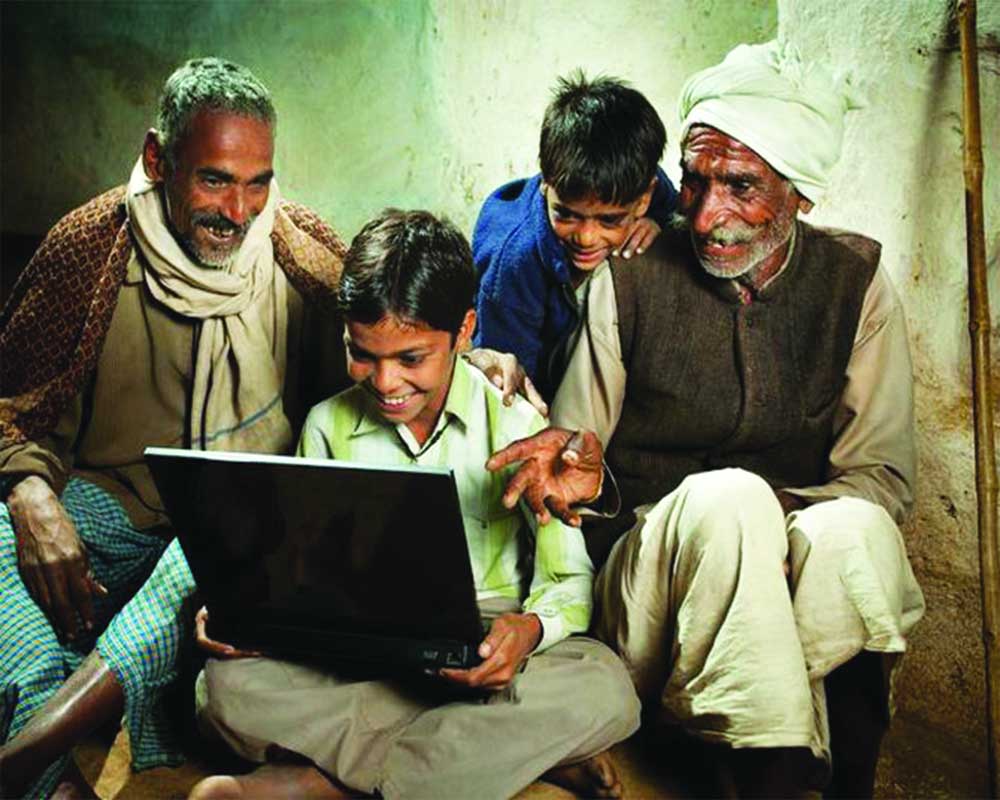
Still there are people who can’t access the internet as they don’t have smart phones, laptops, gadgets and other mandatory devices. Therefore, a digital divide is explicitly emerging in India, which might result in massive gaps in access to the internet in the age of a network society. The huge cost of access to and the use of new technology will set the stage for a digital divide i.e. digital discrimination. Digital illiteracy is also on the constant rise in India. Paradoxically, the Government is claiming to be manufacturing the base at a breakneck pace for Digital India, without addressing these unrelenting problems.
Leading theorist of the information society, Frank Webster argues that the new society is more of a theoretical one. The construction of these theories will determine the democratic and egalitarian patterns of this new age. If these ingrained flaws formed during the construction of theoretical knowledge are rectified, it would foster a sustainable information environment.
Undeniably, at this epoch, we have information in abundance and fewer instruments to certify authenticity, relevancy and beneficial information, which set the score for the post-truth age. Meanwhile, still, some of them could not enjoy the enormousness of information. Hence a parallel, mammoth building in the internet society is constructed, wherein digital slums will find a permanent place, without any trace of their digital history.
(Writer: Mohammad Irshad / Arnisha Ashraf; Courtesy: The Pioneer)

Not good enough
by Opinion Express / 12 December 2019By effectively allowing every Central agency to snoop on private data, the data protection Bill needs a relook
The latest draft of the Personal Data Protection Bill, 2019, which is doing the rounds of Parliament, seems to have ruffled many feathers while pleasing some quarters at the same time. At first glance, it appears that the Bill has plugged many loopholes. It categorises data into three categories — critical, sensitive and general — and calls upon social media firms to create a mechanism to keep a check on trolling. But it has also made some glaring exemptions. It has granted Government agencies the complete authority to access personal data of Indian users without the need for a court warrant. This, the Government feels, is in the interest of the country and will protect its sovereignty and integrity besides maintaining public order and developing friendly relations with other nations. The provisions of the Bill are in sharp contrast to the recommendations made by the BN Srikrishna committee last year. It had recommended that “processing (collection, recording, analysis, disclosure, etc) of personal data should be done only for clear, specific and lawful” purposes. The current Bill does away with the need for definition of any sort. Moreover, the authority for protecting personal data is vested with authorities in the Government and bureaucrats. This, in essence, will give rise to a conflict of interest as it is the Government against whom the public wants to protect data. Then the larger issue of data brokers, companies who routinely buy and sell data even outside the country, remains unaddressed. Worse, their modus operandi is one that comes within the legal boundaries. While demands for localisation have been made, they do not figure in the current scheme of things. Besides, localisation alone cannot ensure that the data will be protected within domestic confines, for even if the broker is located, is there any provision that can hold him/her accountable? While there is little doubt that certain aspects of information cannot be made fully private, fiduciary information, for example, much of that data is already known to many agencies. And on this count, several Indian firms have proven themselves to be particularly inept at handling it. Leaks, both inadvertent and malafide, are extremely common across the country. Whistle-blowers, who expose the dark and dirty deeds of wrongdoing in the corporate sector and the Government, leave a potential grey area for the misuse of personal data in the country.
With search engines very conveniently being left out of the latest draft Bill, it appears that the public affairs folks at Google must be pleased as punch. But is that one exemption too far as well? Nobody is debating that in a country like India, personal data, even at a very granular level, is important to provide better public services. Most importantly, better information can lead to massive cost savings and other efficiencies. Unlike many Western countries, where the public at large is very touchy about their personal data, in a country as large and diverse as India, things unfortunately have to be slightly different. At the same time, it is also evident that India has a high incidence of tax avoidance and all sorts of small scams that rob the public exchequer and taxpayer. Better analytics should make those crimes less prevalent, although they won’t remove them altogether. Then there is the provision called the “Right to be Forgotten,” which should allow individuals to have some of their personal data removed from the internet. While this copies the European legislation around the same topic, the practicality of such a provision in India, which is likely to be misused by conmen and fraudsters to remove unflattering remarks, is questionable. There are concerns still about the unpreparedness of offline businesses to duly comply with the provisions of the Bill. Of course, this is just a draft provision and unlike many other Acts, which the Government is pushing through, this Bill is going through a Select Committee. Hopefully, all political parties will appoint their smarter and digitally aware parliamentarians to this committee to represent them. The data protection Bill should not be rushed through. It is a Bill that will be very important for the digital future of this country and indeed the world.
India’s greatest export
by Opinion Express / 05 December 2019‘Make in India’ might be in the ICU but as Pichai’s elevation shows, Indian brains are still in demand
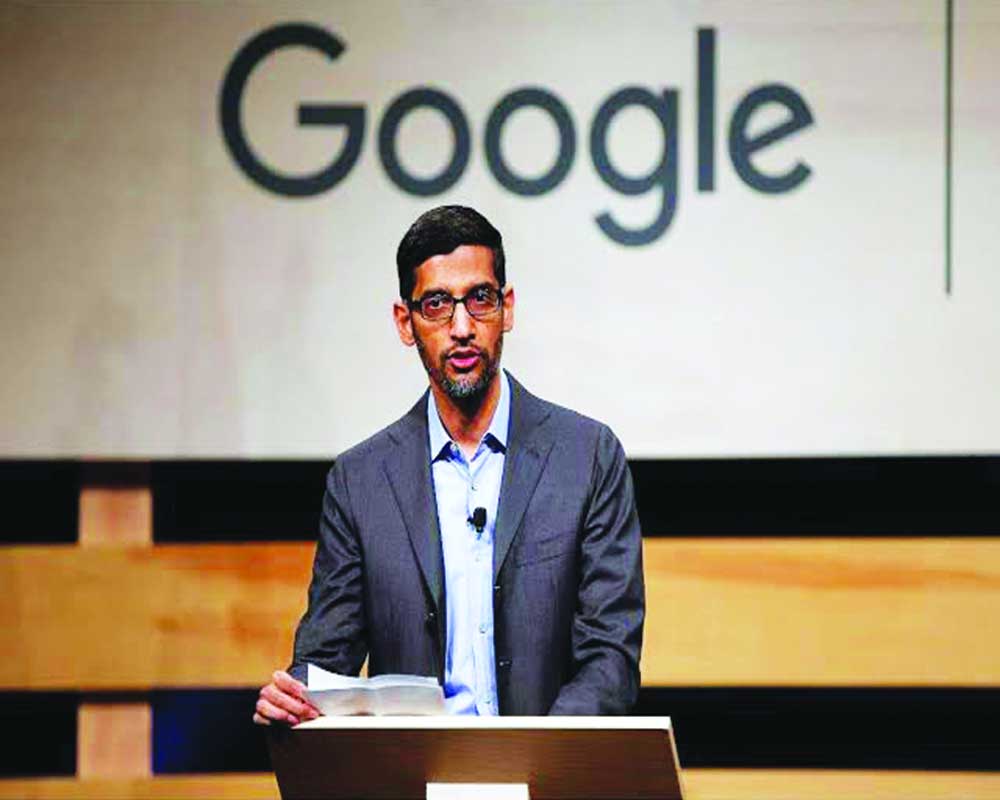
The world may not run on Made in India cars or necessarily wear clothes made in an Indian textile mill or even use Indian weapons but almost every citizen has been touched by software and hardware engineered by an Indian. Now, the news that Sundar Pichai, the boss of Google, is about to become the top dog at Alphabet, Google’s parent company, is something that should be celebrated. He, of course, will not be the first Indian to head one of America’s top companies. That honour went to Satya Nadella, who has quietly and surely been heading Microsoft for five years now. Nobody really knows the secret sauce that makes Indian engineers and managers such great corporate leaders. At one level, it is depressing that Indians have to go to the US and to a lesser extent the UK, to discover their ultimate potential. While the success of people like Nadella and Pichai is a matter of great pride for Indians, it is also an awful indictment of the Indian system where mediocrity rules the roost because success is not encouraged through a competitive format or celebrated.
This is evident in a system, where churning out millions of graduates is seen as more important than the concept of excellence, where education for education’s sake matters more than the actual results. One has to encounter a comical situation where you have an apparent doctorate holder applying for a peon’s job. This isn’t an indictment of the lack of jobs but one where the education system has failed us. Because mediocrity is celebrated at the cost of excellence. India continues to suffer immense brain drain because the best and brightest have little choice but to go abroad to fulfill their potential. Of course, India has many ills that the system is aiming to correct, particularly the caste system and the lack of social inclusion but social mobility will come not just from reservations. A serious audit must be done on the reservations in educational institutions even though the idea itself is an anathema to any mass politician. We have to look at the conclusions of the education system and not just the stories of Pichai and Nadella. We have to question why they had to leave the country? And why neither a Nadella or Pichai couldn’t be heading a global top-100 out of India instead. Of course, the US will continue to attract the best and brightest from across the world. That is what makes that country great. But in celebrating Pichai, we should not miss the opportunity to introspect.
(Courtesy: The Pioneer)

Pegasus misadventure
by Ajoy Kumar / 29 November 2019One of the greatest threats to democracy is when fear prevails about a big-brotherly monitoring of independent thought. This is what the WhatsApp snooping scandal showed
Some time back, in these columns, I had written about the need to come up with a better understanding of our policies. I had mentioned about a study set in an office environment where the purpose was to examine how people react when they know they are being watched. The subjects were divided into two categories: The first group of people was asked to make private donations through a letter or email. The other group consisted of those who would sign up a sheet displayed in the common area of the office. It would also mention the amount committed by them. It was found that people were more likely to donate and be generous when they knew their behaviour would be judged or viewed, in that particular case, by their fellow peers. The crux of this experiment was that people behave differently when they know that their behaviour is being monitored or watched.
While this study looked at the positive impact of such an examination, it is also true that one of the greatest threats to a democracy is the fear that independent thought and criticism of a Government cannot be aired freely because one is being monitored. It is in this context that the recent, frankly terrifying, incident of Whatsapp snooping and hacking of mobile phones of several Indian rights activists must be examined. I presume the readers remember what actually happened. I say this because given the existing climate within the country, it is hard to keep track of one crisis as there are so many more mushrooming concurrently. The issue of an Israeli software, Pegasus, snooping on Indian citizens’ accounts came to light at the beginning of this month. This should have been one of the most significant topics for discussion. But unfortunately, several other crises emerged over the month: The illegal operation of electoral bonds, the Maharashtra imbroglio and the NSSO report claiming that consumer spending and sentiment is at its lowest in 40 years, among other issues.
Honestly, even I forgot about the snooping incident. Until the day I was speaking to a friend over phone, who also happened to be a bureaucrat. He was criticising some of the policies of the BJP Government but before doing so, he became conscious and asked me to call him up on WhatsApp. He feared that regular channels of communication were being tapped or examined in one way or the other by some department of the Government. Yet my friend wasn’t committing any wrong; he just wanted to air his views about the many shortcomings of the current Government as a regular citizen. He was too afraid to continue through a regular call. My friend is not the only one. Even my grocer insisted on talking over WhatsApp rather than making regular calls after the recent news of Pegasus tapping Indian citizens’ phones went viral.
What we know about the “WhatsApp snoopgate” till now is as follows: It was reported in the beginning of November that around 17 Indian activists and lawyers were spied upon by Pegasus. They were targetted using the popular WhatsApp messaging platform. This is done by either giving a missed call on WhatsApp or through a message on the platform. This allows Pegasus to gain access to the device, essentially all your photos, files and emails.
Pegasus, which is owned by an Israeli group called NSO, has been sued by WhatsApp for its activities. NSO’s defence or response when these facts came to light was that it sells the Pegasus software only to Government intelligence agencies to enable them fight terrorism and serious crimes. Its statement also went on to clarify that it does not sell the software for use against human rights activists and journalists.
However, this is exactly how it was put to use in India. The BJP Government responded by asking WhatsApp to explain why the data breach happened. As per news reports, in response, WhatsApp stated that it had informed the Indian Government about the data breach in May and then again in September. Thereafter, a parliamentary committee was formed to look into the breach, among other things. According to reports, after some pushback and non-cooperation, this committee will try to get some answers from the relevant wings of the Government.
The primary issue, however, with such a grave and serious case is that it is a reminder to the people that their lives are no longer private. It is important to remember that the Supreme Court had itself stated that the right to privacy is fundamental as guaranteed under the Constitution. The familiar refrain of any Government, especially the current one, is that these rights are subject to reasonable restrictions. But what’s common between bureaucrats and grocers alike is that they are genuinely afraid of speaking against the policies of the Government, for this may affect them adversely. There is no denying the fact that this fear psychosis exists and the environment creating this mindset is problematic on its own.
There are many questions regarding Pegasus that must be answered but the most basic question is: How was a software — sold only to Governments and enforcement agencies to tackle terrorism — used to target human rights activists, journalists and politicians? This is an uncomfortable question that the Government must answer and it must do so for its own benefit.
This incident has heightened the fear factor among the citizens. They worry that critics are being monitored and that they may be spied upon without following the due process of law.
The breach of an Indian citizen’s privacy, with no regard to established procedures, is egregious if true. However, even the belief that this is an accepted state of affairs today is problematic. Such fears lead to a “chilling effect”, where people will be more fearful about criticising the Government. What will be even worse is that this fear will prevent the Government’s failures from coming to light in public.
All of this will make the Government a non-transparent organisation, one that answers only to itself or to a privileged few. Indeed, this would be a travesty. A Government, we must not forget, is an agent of its citizens. It was elected by the people to act for their benefit. It has not, by any stretch, been empowered to snoop on lawyers and journalists who question it unless, of course, our new definition of a terrorist is a person who does just that. In which case, our worst fears have already been realised.
(Writer: Ajoy Kumar ; Courtesy: The Pioneer)

Taking Big Risks for Bigger Rewards
by Anugula Rakesh Reddy / 10 September 2019Post the Chandrayaan-2 setback, some may question the ` 970-crore investment in space but this will pave the way for India to tap into trillions of dollars worth of lunar minerals
In science, there is no such thing as failure. There are only experiments and efforts.” With these words, Prime Minister Narendra Modi consoled a crestfallen nation after India’s moon lander Vikram was unsuccessful in descending on the lunar surface smoothly. Some may question the `970 crore ($140 million) price tag of the Chandrayaan-2 mission. But this investment will eventually pave the way for India to tap into the trillions of dollars of mineral wealth on the moon and near-earth asteroids.
To many, this may sound like science fiction, but several national space agencies including the US’ National Aeronautics and Space Administration (NASA), the European Space Agency, Chinese Space Agency, Russia’s Roscosmos, the Japanese Japan Aerospace Exploration Agency (JAXA), are already mapping and exploring the lunar surface and nearby asteroids.
Many private players like Moon Express, Astrobotic Technology, Blue Origin, iSpace and so on have serious commercial plans for lunar prospecting as well. The Indian Space Research Organisation (ISRO), too, completed our first mission to the moon, Chandrayaan-1 in 2008, with great results and now Chandrayaan-2 is expected to take it forward with a mission life of up to seven years. The moon isn’t so far out of our reach after all. Actually, it’s only a two-three day journey, which is shorter than the 79-hour journey on the Kanyakumari-Dibrugarh Vivek Express!
The technology to exploit lunar resources, though immature, is around the corner. The first lunar rover was launched in 1970 by the erstwhile Soviet Union, a year after the first human lunar landing by the USA. Safely landing and remotely driving a car-sized eight-wheeled vehicle on the moon’s surface back in 1970 was a gigantic achievement. The technology was re-used in 1986 to clear radioactive debris inside the Chernobyl Nuclear Power Plant in the aftermath of the nuclear disaster there. In 1997, NASA’s Sojourner rover became the first rover on Mars, followed by rovers Spirit in 2004, Opportunity in 2004 and Curiosity in 2012. China landed two of its rovers on the moon, Yutu in 2013 and Yutu-2 in 2018.
India started its moon exploration mission with Chandrayaan-1, announced by Prime Minister Atal Bihari Vajpayee in 2003 and launched in 2008. ISRO’s Moon Impact Probe confirmed the presence of water in the lunar soil, whereas NASA’s Moon Mineralogy Mapper instrument on-board looked for minerals across the moon’s surface. Interestingly, Chandrayaan-1 was also looking for Helium-3. This specific form of Helium, scarce on earth, is abundant on the moon’s surface. But why are ISRO and other space agencies looking for it? The answer is potentially abundant, safe and clean nuclear energy hidden in it. While Helium-3 fusion technology is laboratory-proven, it isn’t yet commercially viable. Helium-3 also finds applications in cryogenics and medical imaging.
Rare Earth Metals (REMs) are indispensable for modern electronics. China has already cornered 90 per cent of the supply and is aggressively capturing more. While only limited sources of REMs have been found on the moon, NASA still considers it important to be able to mine it, given its critical importance. Further, the moon also has concentrated deposits of titanium, a metal critical for advanced weaponry.
However, the big question remains if lunar mining will ever become commercially viable? For that, we need to look at other maturing knowhow that will benefit lunar mining technology. Reusable rockets, as demonstrated by SpaceX and Blue Origin, are set to disrupt the launch industry. Other Government and private agencies are furiously trying to emulate the same to remain competitive. Space transportation costs are expected to go down significantly. With equipment delivered to the moon, advanced construction robots will assemble mining facilities.
Also, 3-D printing technologies will allow forging smaller parts and replacements. Autonomous vehicle technology being pioneered by the likes of Google, Tesla and Uber can be re-purposed for automated prospecting, extraction and movement of lunar mining vehicles. Advances in industrial robotics will lead to automated ore refineries, with lunar mining vehicles dumping raw ore at one end and refined product coming out of the other. Human supervisors would stay in habitats built into the lunar caves, similar to the International Space Station.
It is not just one technology in isolation, nor just one mineral that will seal the deal. When taken together, we can see a reasonably positive picture emerge. The likely trajectory of lunar mining will probably start with surveying and small sample-return missions. These will eventually grow in scope with small factories and minor human settlements, before growing into a large industry.
In 1957, the Soviet Union launched the first satellite in orbit. Just six decades later, global space activities are valued over $350 billion as revealed by a Morgan Stanley report, with projections to reach over a $1 trillion by the 2040s. NASA estimates that the present lunar resources are worth hundreds of billions. But the moon is just a test bed of sorts for asteroid mining and Mars colonisation, where there are even more resources to be harnessed. The website Asterank lists several near-earth asteroids and their potential financial value. Asteroid Ryugu, that is orbiting between the Earth and Mars, has an estimated $80 billion worth of minerals. Japan’s Hayabusa 2 touched down on it earlier this year and is expected to return with a sample next year.
In the ancient Indian epic Mahabharata, after the devastating war between the Pandavas and the Kauravas, the oldest of the 100 Pandava brothers, Yudhisthira laments over his depleted treasury. However, Ved Vyas tells him of the great Mount Meru (the sacred five-peaked mountain of Hindu, Jain, and Buddhist cosmology that is considered to be the centre of all the physical, metaphysical and spiritual universes) in the inhospitable reaches of the northern Himalayas that has an abundance of gold. Yudhishthira launches an expedition to mine the mountain and thus replenishes his kingdom’s coffers.
We are an ancient yet continuing civilisation. For centuries, India was at the forefront of several technologies, especially metallurgy, textile, civil engineering and agro-tech. While large-scale space mining and colonisation are still decades away and are fraught with millions of dangers and hurdles, no civilisation can propagate itself unless the present generation plans and invests for the future.
In 2018, the Modi Government restarted the ambitious Indian Human Spaceflight Programme by announcing budgetary funding for the programme and Gaganyaan, an Indian crewed orbital spacecraft, is intended to be the basis of the project.
The programme will eventually help establish a domestic space tourism sector and perhaps decades later, lead to an Indian moon base. We owe it to our descendants to give them a head start when they take over the reins of India.
(The writer is Telangana BJP spokesperson, economist and Director, Centre for Leadership and Governance, Hyderabad)
Writer: Anugula Rakesh Reddy
Courtesy: The Pioneer

Need Better E-Commerce Policies to Reap Benefits
by Megha Patnaik / 06 September 2019India must understand which e-commerce policies can create uncertainty for firms as addressing them will help it reap benefits innovative technology companies bring
During Amazon’s second quarter earnings announcement recently, its Chief Financial Officer (CFO) Brian Olsavsky commented on India’s e-commerce policy and expressed the hope that the Government would provide a stable and predictable policy for the company to continue with its investments in technology and infrastructure. This demand is a new addition to the e-commerce debate and a novel one given that it is coming from a firm already heavily invested in India.
India must understand which policies in the e-commerce space can create uncertainty for companies, as addressing them will help the country reap the benefits innovative technology companies can bring to the table. Amazon services bring in jobs and investment to local economies globally and in India, along with innovation and knowledge that will help companies grow and improve productivity.
Amazon’s inauguration of its Hyderabad-based office, that is the single-largest till now globally, housing 15,000 employees across 1.8 million square feet of space, is proof that it considers India a viable business environment despite the regulatory hurdles faced in tariffs, taxes, stringent Foreign Direct Investment (FDI) norms and ever-changing data regulations.
Globally, site selection by large multinationals follows an intensive bidding process, with US states offering incentives to woo them. Last year, the firm narrowed down its Amazon HQ2 locations, choosing Northern Virginia over New York. There were a total of 238 bids for the site. Some states, most notably New Jersey and Maryland, offered multi-billion dollar incentive packages — $7 billion and $8.5 billion, respectively — to Amazon, but did not make it to the shortlist. After taking into consideration the existing availability of skilled workers, the infrastructure, cost of doing business and a stable business environment, the tipping factor which influenced the location decision was the pushback in the New York location, in contrast to a warm welcome from the community in Virginia, despite its moderate offer of $750 million in incentives.
Governments bid aggressively and offer incentives to attract successful multinationals as these firms generate economic activity through supporting and linked businesses, upskill workers and increase the uptake of more structured management practices, thus improving the overall productivity of local companies.
Recent research found that such million-dollar plants lead to significant increases in management, productivity and employment by the incumbent firm that boosts the local economy.
There is a stronger effect through companies which are in sectors where there are frequent flows in managerial labour from the plant’s industry, found by comparing incumbent firms in locations, which were the winners of the bidding process with the runners-up who narrowly missed being selected for the site.
Policy uncertainty deters companies from investing and hiring. When organisations are unclear about the future economic environment, they hold back on investing until policies become clear. Productivity growth also falls because this pause in activity freezes reallocation across units. In the medium-term, the increased volatility from the shock induces an overshoot in output, employment and productivity. Thus, uncertainty shocks generate short sharp recessions and recoveries.
All this affects long-term investments that are irreversible in nature and for which horizons for cost recovery can run into years. This would include innovation and research and development investments, ventures into new markets and infrastructure development. When there is a lack of stability and certainty in the future actions of the Government and regulators, enterprises hold back from investing in these dimensions. This, in turn, limits the impact of such firms that can come from long-term investments, including benefits to employment, wages and growth.
The role of economic and policy uncertainty at the macro-economic level has been measured globally and has recently been highlighted in the 2019 Economic Survey. An index is created by quantifying newspaper coverage of policy-related economic uncertainty mentions in the national newspapers, through combinations of keywords related to policy and uncertainty. This measure correlates strongly with stock market volatility measures, such as the India VIX Index. This measure is used globally to study the effects of events such as Brexit, the US-China trade wars and so on.
A less understood concept is that enterprises can also face uncertainty at sectoral, geographical and individual levels. Industry-level uncertainty can be measured through surveying firms sampled across sectors, asking them about expectations of future growth and costs at various horizons. Though this is harder to capture, it is amply clear that Amazon’s statement alludes to policy uncertainty in the e-commerce space.
Here are a few of the policies in the e-commerce space which increase uncertainty for businesses and thus deter investment: The draft National e-Commerce Policy rules earlier this year, preventing companies from influencing prices or selling products in which they hold stakes, disrupted business plans for e-commerce firms. It pushed firms back to the drawing board to ensure they can comply with the current regulations while limiting losses that arose from lack of clear direction from the start. The final e-commerce policy has been held back for another year, putting the investments of businesses in this sector in jeopardy during the interim months.
The recent recommendation by a high-level Government panel to do away with the need for foreign firms to store a copy of all personal non-critical data in India will help companies, though the decision on data localisation remains to be made.
Under data localisation, foreign companies would need to redesign internal algorithms to access data locally, pay up for new servers and face costs to protect data in less-secure environments. There is also uncertainty as to what constitutes non-critical data and how it would interact and overlap with critical data. E-commerce companies still face policy uncertainty while the due process of discussions with various Government bodies and stakeholders regarding data localisation is completed. We soon expect to hear from the Prime Minister’s Office on data localisation. The announcements, though not final, do offer direction and some insights into the Government’s thought process.
A related issue is the disclosure requirement of source code under the draft e-commerce policy. Amazon depends highly on data-driven marketing and heavy use of its item-to-item collaborative filtering algorithm for customer recommendations.
A code submission requirement is a coercive technique aimed at achieving the transfer of technology and local needs. Technology transfers happen in an organic and legitimate manner through managers and employees developing skills and passing them onwards in data communities or by moving across companies. Whether this will come into effect through the final e-commerce policy will remain unresolved till mid-2020.
Multiple guidelines can also cause delays in the resolution of uncertainty. The RBI’s Report of the Working Group on FinTech and Digital Banking includes e-aggregators, Robo advisers and Big Data all under FinTech. E-commerce firms, which are data-intensive and provide multiple services, will be included under this description. The Ministry of Finance FinTech Steering Committee report remains pending that will recommend another set of guidelines on regulation around technology-enabled activities in India.
For India to reap benefits from global multinationals such as Amazon, we need to provide companies exactly what they are asking for — a stable and predictable policy environment that can foster investment and infrastructure development.
Early investments from large innovative companies will give a head start to India, enabling it to pick up technologies from global leaders and push domestic innovation forward faster as well. This is critical for a capital-scarce country like India, which is aspiring to become a $5 trillion economy in the next five years.
(The writer is faculty, ISI Delhi and Fellow at the Esya Centre)
Writer: Megha Patnaik
Courtesy: The Pioneer
US Draws the First Blood Against China
by Bhopinder Singh / 20 May 2019By signing an executive order to protect its networks from foreign espionage, the US has drawn the first blood on what was hitherto whispered as a need to counter Chinese ambitions
US President Donald Trump recently signed an executive order on ‘Securing the Information and Communications Technology and Services Supply Chain’ that effectively walked the talk on clamping down on the growing Chinese presence and influence. While the order itself was ostensibly country-agnostic and company-agnostic, the unmistakable target was a leading Chinese company, Huawei. Predicated under security concerns, the statement from the White House said that the order, “declares a national emergency with respect to the threats against information and communications technology and services in the United States (US) and delegates authority to the Secretary of Commerce to prohibit transactions posing an unacceptable risk to the national security of the US or the security and safety of its people.” Soon, the US Commerce Department added Huawei to the ‘entity list’ of banned organisations. Against the backdrop of the ensuing US-China trade wars, this latest American salvo has huge implications for Chinese products and services going forward, as it questions the construct of “Made in China,” given the inextricable and complex Government-industry interlinkages that beset the ownership, interests and operations of major Chinese organisations.
Unlike most unilateral decisions initiated by Trump, this executive order had bipartisan support across the political divide, symbolising the overwhelming threat perceptions within the US that are emanating from China. The Huawei action was looming for some time and the US had been sabre-rattling on the same with other Western powers. While Australia had acceded to the warning and banned the organisation earlier, the European nations were sceptical about the US’ seriousness. Given that the Chinese multi-national had outmanoeuvered the European companies like Ericsson and Nokia in grabbing market shares across emerging markets of Africa, Latin America and Asia — the expectation of reciprocal protectionism would rise within Western capitals to support their own organisations as the Chinese state does.
The US went as far as threatening its allies to withdraw “intelligence” inputs unless they stopped using the Chinese manufacturers like Huawei for building their 5G infrastructure. At the heart of the fears is the new internet architecture that could possibly “link” industrial equipment, personalised data, security cameras and civic facility details among others and transport the data dump to a repository in China, from where a apocalypse-like situation of a virtual “shutdown” of American military-economic-civic infrastructure could be effected if China so wanted in a crisis!
Given the Chinese ambition, investments and strategic outlook, such fears of data protection are not entirely unfounded. Expectedly, the Chinese have likened the US move to a “cold war mentality” and alluded to the US fears as unsubstantiated paranoia. Given the construct of the organisation itself and the rules governing its principal place of origin and headquarters ie, China, it is certainly obliged and vulnerable to the diktats of its Ministry of State Security.
Like most Chinese offerings, the winning appeal of Huawei was in its cost-effective technology and terms of trade. However, the recent move has added a ‘non-commercial’ angularity of dealing with Chinese companies. Last year, the global list of top 500 companies, as measured by Fortune magazine, had an unprecedented 120 Chinese companies making the cut (just shy of 126 by the leading nation, US). This sudden emergence of Chinese companies owes its success in huge measure to the complex commercial-political wiring of Chinese organisations that baffles most corporate-watchers as to their real ownership and control structures. Founded in 1987 by a former People’s Liberation Army (PLA) officer, Ren Zhengfei, who now owns only one per cent of share, it has grown into a $106 billion global conglomerate with a mammoth $14 billion dedicated towards R&D. Despite its immense size, scale and the competitive intensity of its domain, it still grew at a staggering 21 per cent over the previous year. Today, it serves 45 of the top 50 telecom operators worldwide and its network already reaches one-third of humankind. Somewhere, questions abound about such rapid rise, access and the ‘invisible-hand’ that drives such surreal growth. Given its formidable presence and invaluable necessity in the infrastructure of some third-world countries, it will not be easy to ‘ban’ its products across such countries — though it certainly marks the beginning of larger implications for ‘Made in China’ that go beyond a corporate entity.
Partly on account of genuine fears and partly on account of the escalating trade war, the recent US move has drawn the first blood on what was hitherto whispered as a need to counter the Chinese juggernaut. In a barely veiled threat, the Chinese have reminded the US about its own vulnerabilities with American organisations like Qualcomm, who generate over half of their revenues from China, as indeed the likes of Intel and Apple, who rely on Chinese parts and market! Many of China’s strategic sovereign imperatives like the ‘One Belt, One Road’ or in this case, the ‘Digital Silk Road’, which promises hyper speeds and capacities of 5G (promoting ‘Internet of Things’) communication, envisages a pivotal role for organisations like Huawei. The sovereign intent on becoming a Cyber and Artificial Intelligence (AI) superpower has fuelled the Chinese State to support and fund many aggressive and audacious investments that make the world nervous, given the known Chinese ambitions and penchant for means. The temerity and commitment behind developing cutting-edge technology that could have multiple “spin-off” usage and data-sharing has the Western world worried.
The Chinese are past masters in reverse engineering and sourcing technology licitly and illicitly, especially in matters of defence equipment and overall security preparedness. However, due diligence and care has to be ensured with evidentiary proof of potential misuse or “leakage” before censuring or ascribing any questions on the Chinese organisations as it should not violate the principle of fairplay in the global economy. The onus is now on China to demonstrate transparency and unveil its control and command structures behind its corporates as also convince the wary world of its intentions and ambitions. Unfortunately, it will be an uphill battle for China given its history and its prevailing instincts to convince the world, otherwise.
(The writer, a military veteran, is a former Lt Governor of Andaman & Nicobar Islands and Puducherry)
Writer: Bhopinder Singh
Courtesy: The Pioneer
FREE Download
OPINION EXPRESS MAGAZINE
Offer of the Month